Posts

Showing posts with the label Olympus

New Views with Something Old

Image
 A few months ago I did a bit of camera and lens trading/buying to return to the basics of the micro four thirds format: smaller is better. I acquired a very good, used Olympus OM-D E-M5 Mark III camera and an excellent-condition Olympus M.Zuiko Digital 17mm f1.8 lens. E-M5 iii with M.Zuiko Digital 17mm f1.8 and Olympus LH-48B lens hood. The used lens, introduced in December 2012, actually came with an Olympus-branded lens hood. Now that I am a "senior" -- old -- and use a cane for walking, I need to have my camera attached to a neck strap, often shooting with one hand. This combination is perfect for that. The 17mm is now my "normal" lens. Cropped image shot with the M.Zuiko 17mm f1.8 on E-M5 iii. I sold my Panasonic Lumix DG Summilux 12mm f1.4, which I acquired soon after it was released in 2016. It is one of the best prime lenses in the MFT lineup, but it was just too bulky and heavy for an old man to deal with. Replacing it was the M.Zuiko Digital 12mm f2.0. Bot...

"Love Is in the Air"

Image
 Here's a composite image from a performance of the Enclave Choir, directed by Meg Miller. The show was a collection of love songs and related narrative. Location: The Enclave at Round Rock senior living center, Round Rock, Texas.  The photo was shot using the M.Zuiko 12-100mm F4.0 IS Pro lens on an Olympus E-M1 Mark III camera. In my opinion, this lens is the best zoom lens ever made for the micro four thirds format. The lens was first released in 2016 but never became a big hit because of its size. I purchased the lens soon after its release. At the time, the only MFT camera I owned was the PEN-F, but it had a third-party grip, making it perfect for balancing the heavier lens. With Olympus cameras, the lens adds 2 stops of stabilization, and it had a manual ring clutch for quickly switching from auto focus to manual focus. The  M.Zuiko Digital ED 12-200mm f/3.5-6.3, one of the last lenses in the pipeline before the Olympus camera division became OM System, was designed ...

My Long Lens Solution

Image
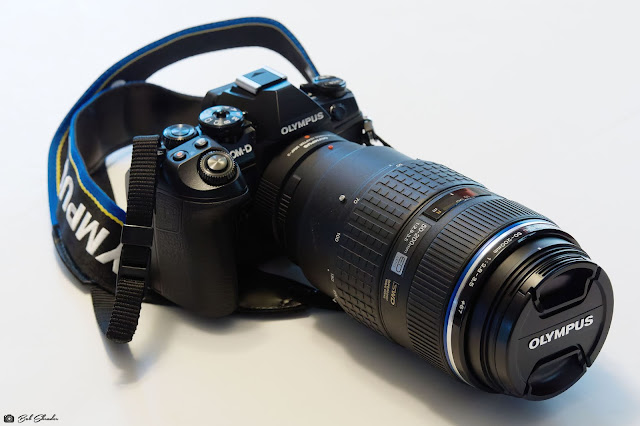
I have found the replacement for my Olympus 75-300mm MFT lens. It's an adapted vintage four-thirds Olympus Zuiko Digital ED 50-200mm f2.8-3.5 SWD lens. The Olympus Zuiko Digital ED 50-200mm f2.8-3.5 SWD with Four Thirds MMF-3 adapter on my Olympus OM-D E-M1 Mark III. The release of the Olympus M.Zuiko Digital ED 100-400mm F5.0-6.3 IS for the micro four thirds system several months ago seemed to be the solution for my need to move up to a longer lens for flower and bird photography. The reviews have been good and the test images I have seen are impressive. However, the $1,500 USD price is a little bit expensive for my budget. I had been using the  Olympus M.Zuiko 75-300mm F/4.8-6.7 ii for several years. It is light-weight, auto-focus is quick, keepers are very sharp, and I can hand-hold throughout its focal range. However, I have often wished for a little longer reach, and the bokeh in shots with defocused background is very unpleasant. Back when an Olympus OM-D E-M5 was my pri...

Closer Look at the OM-System 50mm Macro

Image
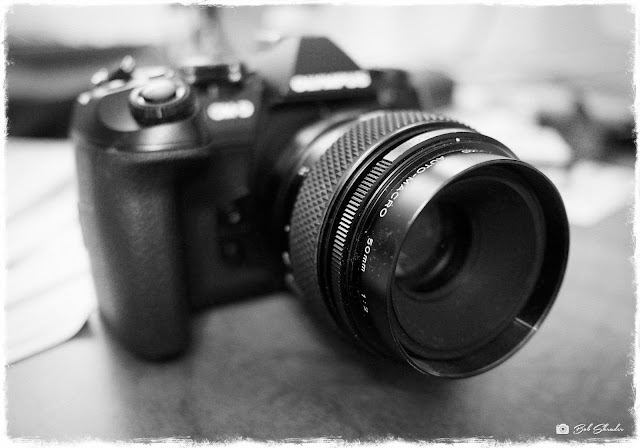
 Here's a black and white image of the legacy Olympus OM-System 50mm f2 Auto-Macro on a modern micro four thirds camera -- the Olympus OM-D E-M1 Mark III. Because this prime lens was designed for SLR cameras, it's big and heavy, although the Olympus OM-System was smaller than other SLRs. The grip and the size of the E-M1 III make it work well on this camera. I would not want to use it on my smaller PEN-F without a grip attached. This copy of the lens, which I acquired used on eBay, is in good shape, and looks great on the camera. The wide rubberized focus ring operates smoothly with its wide throw. For manual focus work, I prefer this approach to the focus-range switches used on later model macro and telephoto lenses. The aperture ring with click stops is located at the front of the lens. A focus-distance scale is found at the back of the lens behind the focus ring. A Fotodiox Pro OM-MFT adapter attaches the lens to the micro four thirds camera. This lens and virtually all of t...

OM-System 50mm Macro Lens on Micro Four Thirds Camera

Image
I have always been a fan of Olympus cameras. My first was an OM-2, a 35mm film camera that was part of what was known as the OM-System. I owned three the OM-System cameras over the years. In addition to small size, a key factor in the success of the OM-System was the quality and variety of lenses. My favorite lens was the 100mm f2.8, rendering beautiful bokeh perfect for portraits. All of these lenses were manual focus. With the decline of film, I moved to the Olympus 4/3 format camera, a digital SLR that introduced me to auto focus. I had the E-420, then an E-620 before Olympus and Panasonic launched micro four thirds. The technical advancements are marvelous, and I am now shooting with an EM-1 Mark III and an MFT PEN-F with fast autofocus prime and zoom lenses. But I miss some of those OM-System lenses, even though they were only manual focus. I recently found a bargain on an Olympus OM-System Zuiko 50mm f2 Auto-Macro lens. Here's an image shot with that lens adapted for use on a...

A Few Words about Lens Caps

Image
I buy lens caps by the two- or three-pack because I lose so many. They fall off the lens while stored in the camera bag. They fall off while stored on the shelf. They fall off – and then down through the drain grate – while walking down the street. They fall off – and then roll into a bottomless canyon – while hiking through the mountains. They fall off – and then into the ocean – while on a whale-watching tour. Lens caps should be sold by the bag like cookies. Not only do I lose lens caps, I break them. If a lens cap falls onto rock, concrete or asphalt, the plastic shatters or cracks. If the plastic survives the plummet, the locking mechanism is damaged. Part of my problem may be related to my choice of camera system. I switched to Olympus micro four thirds cameras soon after they were introduced by Olympus and Panasonic in 2008 because of the smaller size and weight. The kit-lens zooms and the early primes came with clip-on lens caps. When I attached thir...